Cutting ham
Hoof
Although it is generally black in the Iberian 100% zeros (the famous pata negra ham), we can also find it marbled in some strains of pure Iberian (Torbiscal Iberian strain)
Seals
According to the Iberian Quality Regulations, black seals identify the ham or shoulder as a 100% acorn-fed Iberian ham. The seal with the Dehesa de Extremadura PDO logo indicates that it is a product covered by the Designation of Origin. The seal with the Señorío de Montanera logo carries a code to control the traceability of the individual product.
Vitolas
They are placed when the piece is mature and has been perforated.
Cane
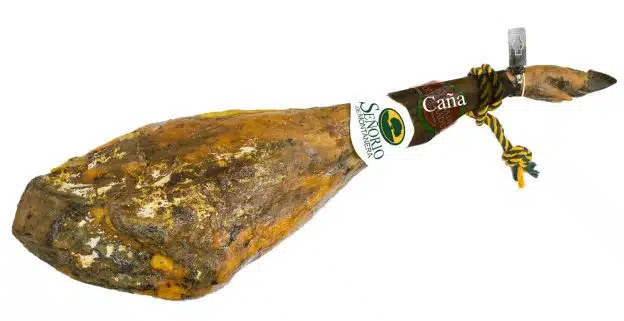
The very fine cane is a symbol of the purity of the Iberian race.
Knuckle
This is the area where the flavor of Iberian ham is most pronounced: sweet and aromatic, with subtle notes of hazelnut. It's a favorite among the most discerning gourmets.
Babilla or Contramaza
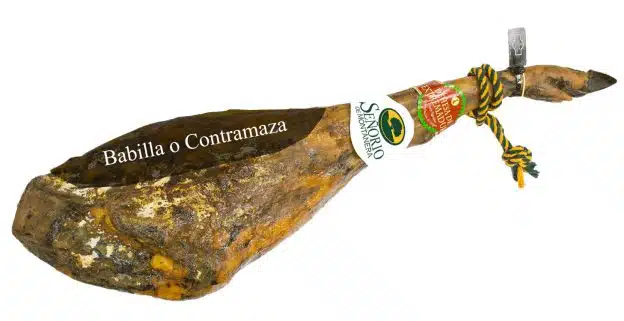
Although more cured and less juicy than the mace, it is an area of very pleasant flavor and texture.
Tip
It's the tastiest part, with a slightly nutty aftertaste. It's recommended to mix it with slices of the maza or rump.
Mace
This is the juiciest part of the cut due to its greater amount of infiltrated fat. The meat from this area is more tender and flavorful, and has an exceptional aroma.
How to cut a ham
To cut Iberian ham, you need the following tools:
- A stable and firm ham holderIf it has a rotating head, it will make cutting much easier.
- A long, flexible ham knifeIt must be very sharp to extract the thin slices.
- A boning knife or paring knife, with a rigid blade and a medium size, which will offer us greater precision in auxiliary cuts around the bones.
- A large paring knife to remove the outer rind and bacon.
- A sharpening steel or sharpener to keep the edge of our knives sharp.
With the hoof facing up or down? It depends on how long you plan to consume our Señorío de Montanera Iberian ham. If you plan to consume it slowly (more than 15 days), which is often the case at home, it's recommended to start slicing the Iberian ham with the hoof facing down, from the rump. This way, the ham will dry out less and we'll get more out of the meat.
If, on the other hand, it is going to be consumed immediately or in a few days, it is ideal to start cutting it from the butt end, with the hoof facing up.
We make a deep cut with the paring knife around the shank, perpendicular to the bone, about 4 cm behind the knuckle.
To remove the bark, we will make a flat horizontal cut from the tip area towards this first cut, always in the opposite direction to the position of your free hand. We remove the yellowish external fat until we obtain a whitish, pinkish, fluid-to-the-touch fat.
With the blade of the ham knife resting on the surface of the Iberian ham, we begin to remove slices with a slight back-and-forth motion without applying pressure to the cut.
The cuts will always be longitudinal to the Iberian piece and parallel to each other., starting the slice right where the previous cut ended and maintaining the direction from the elbow towards the tip.
The ham slices should be very thin, approximately 4-5 cm in size.The ideal serving temperature is room temperature, between 18 and 24ºC.
When we reach the first bone (the hip bone), we will make a cut with the sharp knife around the bone to separate it from the meat and make it easier to remove the slices.
Once we reach the central bone, we will turn the ham over to begin cutting the other side., operating with the same cleaning and cutting process as before.
Once we've turned the ham over and cleaned it following the process described above, we'll continue slicing the ham's side until we have a lateral thickness of approximately 3 cm. We'll turn the ham 45 degrees so that the slicing surface is flat. The reason for leaving this thickness is to achieve slices the same size as those from the ham's side and the rump.
We will continue cutting, extracting slices at a 45-degree angle until we reach the knuckle.
We'll use a boning knife or paring knife to remove all the meat, giving us some delicious ham cubes.
When we reach the bone, we turn the ham again until it is horizontal with the hoof facing upwards, and we will make a deep cut with the skewer to separate the bone from the rest of the meat and remove it by prying it outwards.
This operation will reveal to us the latest flavors of Iberian ham.
Iberian ham should be stored in a cool, dry place. When you're done cutting, cover the cut area with plastic wrap and a cloth to maintain its freshness and juiciness.
At Señorío de Montanera we do not recommend using bacon slices to cover the surface of the ham., since the oxidation of fat can contribute unpleasant flavors to the cut of the piece.